
RESILIENT OPERATIONAL INFRASTRUCTURE
Keep operating when the environment changes.
Resilient Operational Infrastructure helps organisations maintain access to critical digital services when connectivity, infrastructure or central systems are unavailable, degraded or unrelaible.
BMS designs distributed infrastructure around the operational requirement - bringing together connectivity, local compute, edge services, service management, monitoring and support to create a capability that can continue operating when unavailable, degraded or unreliable.

THE PROBLEM
Centralised infrastructure works.
Until it doesn't.




Many organisations now rely heavily on centralised applications, cloud platforms and always-on connectivity. That model works well in stable environments, but remote, distributed and operational settings can introduce very different pressures — from unreliable communications and limited local support to infrastructure failure and loss of access to critical systems.
Connectivity
loss
Degraded bandwidth
Remote
locations
Infrastructure failure
Dependent on central services
Limited local tech support
Resilience is not simply about keeping the network connected. It is about keeping the operation working.
WHAT BMS PROVIDES
A complete capability for operational resilience.
BMS brings together the people, the technology, the processes and the support needed to maintain critical services in challenging environments.

Distributed Operations
Critical services
available close to the
users who need them.

Local Service Availability
Selected applications and services remain accessible when internet connectivity is unavailable.

Resilient Connectivity
Multiple connectivity options designed around the operational environment.

Edge Capability
Local compute and processing where relying entirely on central infrastructure is inappropriate.

Monitoring & Management
Visibility of infrastructure, services and operational health.

Operational Support
Service management, support processes and governance around the technology.
HOW IT WORKS
Maintain capability when connectivity is lost.
The architecture is designed so that critical services do not depend entirely on continuous access to central or cloud-based systems. Key applications, data and services can be positioned at distributed or edge locations, giving users continued access to the capability they need even when primary connectivity is lost or degraded.
Under normal conditions, those locations remain connected to central services and can exchange data, receive updates and be monitored as part of the wider environment. If connectivity is disrupted, local compute, services and data continue to support operations independently, with alternative communications used where available. Once connectivity is restored, information and services can be synchronised back into the wider environment.
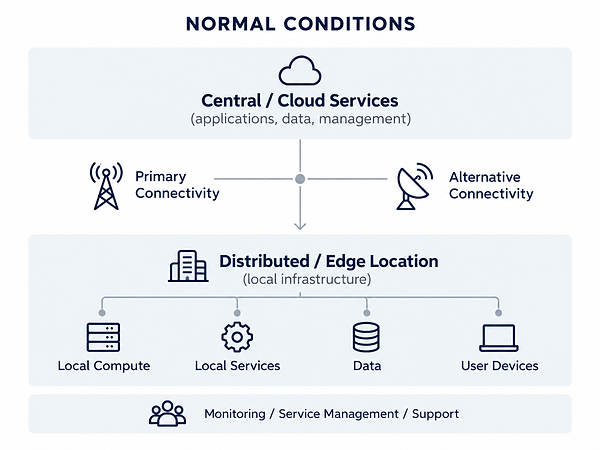

The aim is not simply to keep devices connected — it is to keep the operation functioning.
DESIGNED AROUND THE OPERATIONAL REQUIREMENT
Start with what
must keep working.
Resilience starts with understanding what the organisation cannot afford to lose. Rather than beginning with products, platforms or preferred technologies, BMS identifies the critical operational outcomes that must be protected and the dependencies that enable them.
That understanding allows us to define the level of continuity required and design an architecture that is proportionate to the operational need, risk and environment. The result is a solution shaped around what must keep working — not around a predetermined technology stack.

What we assess.
-
What services must remain available?
-
Where do users operate?
-
What happens when connectivity is lost?
-
What information must remain accessible locally?
-
What infrastructure already exists?
-
How will the environment be supported?
-
What level of resilience is actually required.
WHERE ROI CAN BE USED
Applicable across multiple sectors.
The principles behind ROI are not tied to one environment or industry. They can be adapted wherever operations depend on critical services, distributed infrastructure and reliable access to information — particularly where loss of connectivity or central systems could disrupt the ability to operate. Take a look at some examples of where ROI could be used.

Energy & Utilities
Remote generation, substations and renewable infrastructure.

Critical Infrastructure
Geographically distributed operational sites.

Remote & Offshore Operations
Environments where connectivity cannot be assumed.

Emergency & Contingency
Rapidly deployable or temporary operational environments.

Defence & National Security
Where appropriate.